Three routes, not twenty references
On the moment in a brand voice engagement when the temptation is to present every possible direction. Why we present three, why we kill twelve of our own ideas before we get there, and what the resulting conversation feels like.
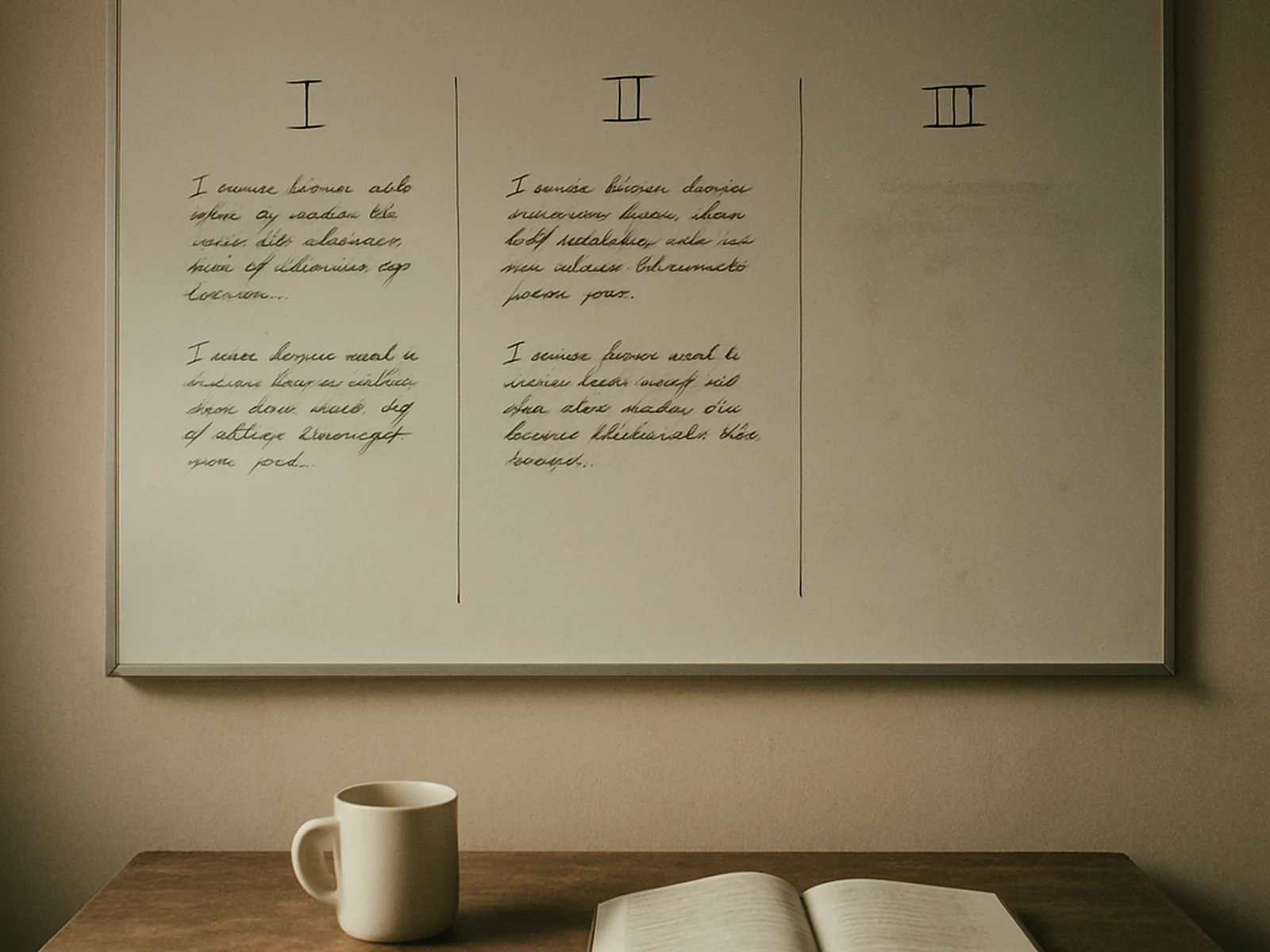
There is a moment, three weeks into a Voice engagement, when the temptation is to bring everything you have considered. Every angle that survived the discovery, every quotation you marked in the founder interviews, every reference brand you read twice. The temptation is to deliver a deck of fifteen possible voices and ask the client to choose. The temptation is wrong. We deliver three.
The reason we deliver three is that the work of a voice engagement is not the work of finding the right voice; it is the work of killing twelve of the fifteen voices that were considered and were not right. The killing is the part of the work the client is paying us for. If we hand them fifteen voices and ask them to do the killing, we have simply moved the work from our office to theirs, at a higher rate per hour, and the client has not gained anything except the impression that the studio is exhaustive.
Three is a deliberate number. Two is not enough because two becomes a binary: either A or B, and the conversation collapses into preference. Four is too many because four allows the client to politely reject all of them on the grounds that none is exactly right. Three is the smallest number that contains a sense of the space — you can see where the voices differ — without inviting the client to escape the decision by reaching for a fourth.
"Three routes, not twenty references" Elias Korhonen · January 2026
The work of killing the twelve is hidden from the client by design. They do not see the long list. They see, instead, three opening paragraphs of the same hypothetical homepage, each written in a different voice, and they know within thirty seconds which of them feels true and which of them feels like a costume. The studio has done the homework. The client is asked to do the recognition.
There is an honesty problem with this approach that I want to name. The honesty problem is that the studio is making a strong editorial decision before the client has seen the field. The studio is saying, in effect, that some of the angles we considered were not worth the client's time. The studio is right about this most of the time, which is what the studio is paid to be. But it is not invisible. We name the choice explicitly at the kickoff: we will bring three, not twenty, and we will be wrong sometimes about the three we chose to bring.
When we are wrong, we are wrong in a recoverable way. The client will say, on the call, "none of these is quite right, but the second one has the rhythm and the third one has the position." We will go away for a working day, write a fourth, and bring it back. The fourth is almost always the one. The fourth is the one the studio could not have written without seeing the client respond to the first three. The fourth is the reason we present three rather than nothing.